How to Specify Touchless Faucets and Soap Dispensers in Bid Documents and Architectural Plans
Touchless is the standard for today's high-traffic restrooms. They reduce water and soap waste, improve sanitation, and cut callbacks—commercial building, hotel, airport, healthcare, higher-ed, and civic facility hallmarks.
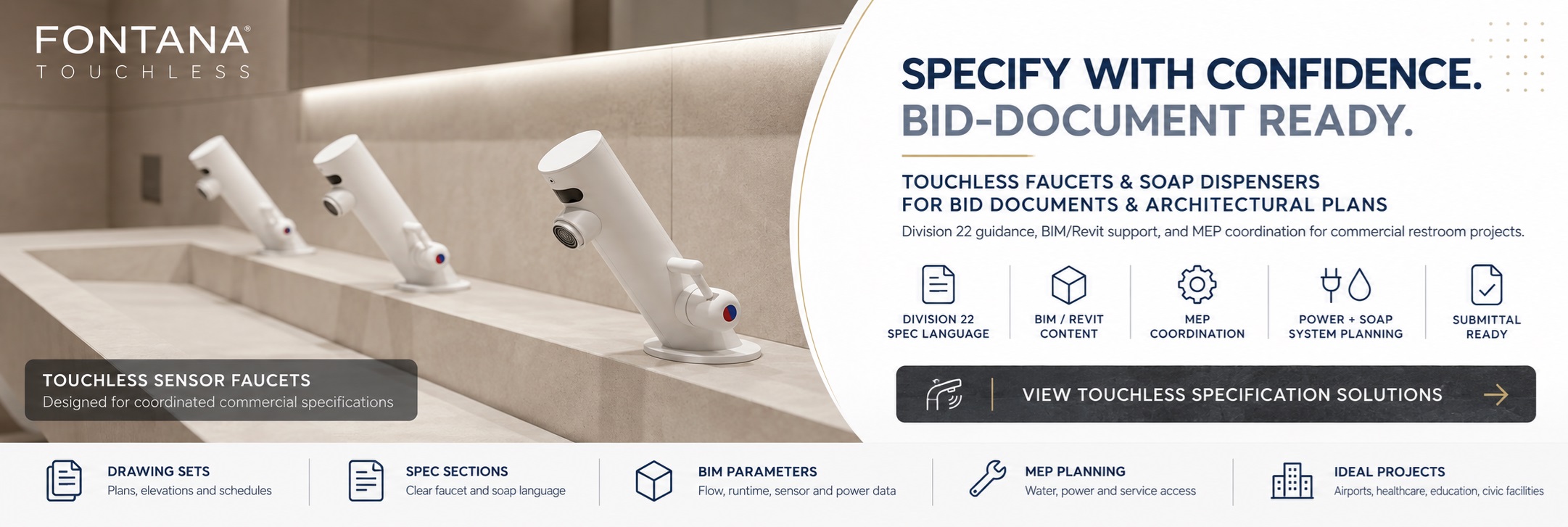
Realizing those benefits consistently, however, depends on rigorous specs and hassle-free coordination among architectural, MEP, and construction documents. This guide walks you step-by-step through what to include in your bid package and drawings, how to write Division 22 language that actually defends performance, and where to find BIM content you can add to your model today. A field-tested MEP checklist is included at the end.
Include performance metrics such as demand flow (gpm), sensor activation range, and operating pressure range tested at both 45 psi and 60 psi to ensure consistent touchless activation and compliance with ADA and WaterSense standards. Cite BIM parameters and specify compatibility with multi-feed soap systems to reduce callbacks, lower water/soap waste, and improve lifecycle cost modeling for high-traffic commercial restrooms.
Read More
Read Less
Final Word
Well-written Division 22 sections, coordinated plans, and current BIM families are touchless from buzzword to measurable outcomes: lower utility bills, faster cleaning, fewer callbacks, and healthier bathrooms. Reference the following sample spec language, refer to current Revit content, and implement the checklist at each stage of design. Your bidders will price apples-to-apples, your owner will get what they paid for, and your users will benefit from the sleek "wave-and-wash" experience they've grown to expect.
Read More
Read Less
Why Touchless is Significant for Large-Scale Bathrooms
Drawing Set & Model—What Goes Where
Architectural sheets (A-series)
Plan & elevations. Show fixture quantities, mounting points,
ADA clearances, and accessories alignment (mirror, deck soap, hand dryer).
Read More
Read Less
Sections/details
Refer to countertop holes, escutcheon sizes, spout reach,
under-counter clearances for soap reservoirs, and service access panels.
Read More
Read Less
Schedules
Employ unique Fixture IDs (e.g., F-401 for faucet,
SD-302 for soap dispenser) with cross-references to spec section and keynote.
Read More
Read Less
MEP sheets (P-series, E-series)
Plumbing plans/schematics. Identify hot/cold feeds,
mixing valves or tempering plans, and pressure/flow assumptions.
Read More
Read Less
Riser diagrams
Show groups with common multi-feed soap systems
and power distribution.
Read More
Read Less
Electrical
Provide dedicated circuits and transformers for hard-wired sensors;
locate power supplies above splash zones.
Read More
Read Less
BIM content & parameters
BIM content & parameters
Use manufacturer Revit families with instance parameters for flow (L/min or gpm), run-time, sensor range, power type, L/R hand reach, and rough-in dimensions.
Tip: Have a BIM Content Register in your model (shared parameter) to track source URL, version, and date last updated. It saves hours of review on submittals.
Touch faucets typically fall within Division 22 42 00—Plumbing Fixtures (or a nearest sub-section such as 22 42 39 Commercial Faucets). Soap dispensers typically fall under Division 10 28 00—Toilet, Bath, and Laundry Accessories.
Most groups, however, stick deck-mounted or multi-feed soap systems with the faucets in Division 22 to cluster MEP coordination.
The below example shows a cross-department Division 22 approach for both, which adds a clarifying sentence.
Sample CSI Division 22 Spec Language (Editable Template)
Section 22 42 39 – PART 1 – GENERAL
Summary: Provide sensor-operated lavatory faucets including spouts, solenoid valves, power sources, mixing/tempering equipment, and accessories required for a complete functional system.
ID, Manufacturer/Model, Mount type, Flow rate, Run-time, Sensor range, Power, Finish, Mixing valve type, ADA notes, Soap type, Accessories.
Keynoting example
K-22-FCT-01: Sensor lavatory faucet, 0.5 gpm, hybrid power, chrome, TMV under-counter.
\A\A K-22-SD-MF-A: Counter-mounted sensor soap, foam 0.7 mL, top-fill, Group "A" multi-feed.
Read More
Read Less
Power. Controls—Details that Prevent Callbacks
Hard-wired vs. battery vs. hybrid: Hard-wired for high-density restrooms, battery for retrofits, hybrid for redundancy.
Electrical coordination: Homeruns at low voltage, transformers out of splash zones, spare VA, GFCI as necessary.
Read More
Read Less
Water Quality, Mixing, and Flow
Temperature stability = fewer sensor complaints. Maintain delivery between 100–110°F. Use TMVs.
Flow & pressure: Call out performance at both 45 psi and 60 psi.
Read More
Read Less
Accessibility, Durability, and Maintenance
Accessibility: Provide ADA clearances, specify spouts long-reach.
Durability & security: Metal housings, PVD coatings, ligature-resistant as necessary. Maintainability: Solenoids repairable, top-fill soap, multi-feed racks.
Read More
Read Less
Submittals & QA—How to Inspect "Equals"
Submittal information: Cut sheets, Revit families, compliance documentation, wiring schematics, soap compatibility.
Mock-ups: On large programs, test basis-of-design vs. equal.
Read More
Read Less
Common Pitfalls—and How to Avoid Them
Uncoordinated hole sizes: Lock early, mark on millwork drawings.
Power supplies in splash zones: Install remotely, above drip loops. Soap type mismatch: State foam vs. liquid clearly. Ignored maintenance path: Locate service zones, cross in plan key.
Read More
Read Less
Final Word
Well-written Division 22 sections, coordinated plans, and current BIM families are touchless from buzzword to measurable outcomes:
lower utility bills, faster cleaning, fewer callbacks, and healthier bathrooms. Reference the following sample spec language, refer to current Revit content, and implement the checklist at each stage of design. Your bidders will price apples-to-apples, your owner will get what they paid for, and your users will benefit from the sleek "wave-and-wash" experience they've grown to expect.
Read More
Read Less
A field-evidence evaluation of dual hands-free operation, infrared response,
deck-mounted coordination, chrome-finish durability, service considerations,
LED temperature indication, and suitability for specification-driven commercial restrooms.
✔ Related Field Record Referenced✔ Healthcare Installation Context✔ Five-Star RatingBoston, Massachusetts • October 2024
Related Commercial Field ReviewTouchless Faucet + Soap SetModel FS11125CH
Aurora Studio Architects — Boston, Massachusetts
Healthcare Fixture Specification / Related-System Evaluation
Review record date: October 16, 2024 • Rating: 5 out of 5
Customer Review
In the referenced healthcare installation, the automatic faucet and touchless soap
dispenser reduced manual contact points while the infrared sensor responded immediately
and accurately during normal restroom use.
Read More
The related field record also noted adjustable soap output, quiet and reliable solenoid
operation, and minimal maintenance requirements. Brass construction and a chrome-plated
finish were reported to tolerate frequent cleaning in the healthcare environment.
Installation
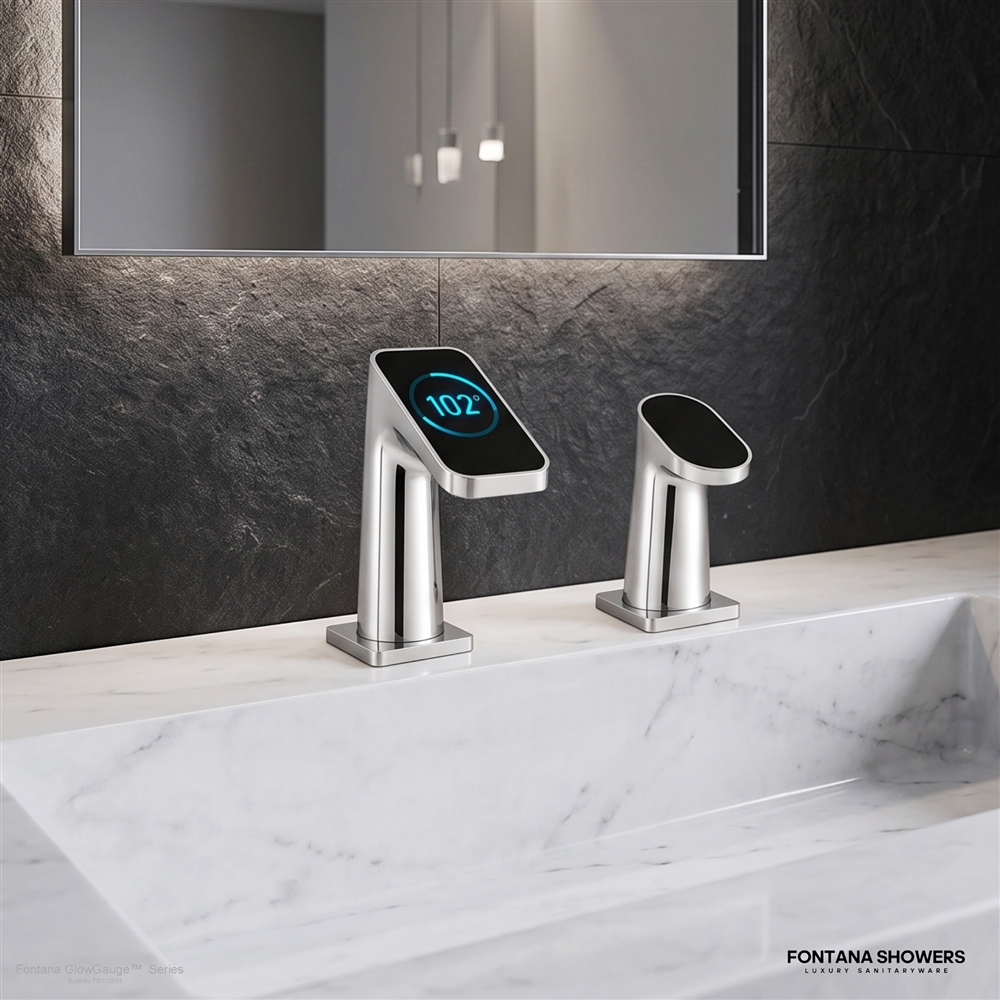
FS11125CH uses a two-hole, deck-mounted configuration that separates the faucet and soap
dispenser across the countertop for a clean and serviceable handwashing station.
Read More
Countertop drilling, component spacing, basin alignment, concealed connections, and service
access should be coordinated before installation. The separated layout can make future access
easier when each touchless component must be inspected or serviced independently.
Sensor Response
The FS11125CH specification lists infrared motion activation with a response time of
0.5 seconds or less, supporting fast hands-free water delivery in commercial use.
Read More
The related healthcare field record strengthens that specification with observed immediate
and accurate infrared response. For commissioning, sensor range should still be checked against
basin geometry, reflective surfaces, ambient lighting, and adjacent fixture placement.
Finish and Design
The polished chrome finish and coordinated silhouettes give the set a clean architectural
appearance suited to contemporary commercial washrooms and specification-driven interiors.
Read More
A related chrome automatic faucet-and-dispenser installation reported good durability under
frequent cleaning-product exposure. The exact FS11125CH finish should still be maintained using
the manufacturer's current care guidance to avoid premature surface wear.
Operating Function
The exact model combines a 1.2 GPM outlet, ceramic valve core, LED capacitive temperature
display, 20–80 PSI operating range, and an adjustable 60-second safety timeout.
Read More
These controls support both user feedback and unattended-flow protection. During turnover,
facilities teams should verify sensor behavior, temperature indication, shutoff timing,
soap delivery, connection access, and routine service procedures as part of commissioning.
Recommended Use
A practical fit for hospitality, workplace, education, transportation, healthcare-adjacent,
and other public-facing interiors requiring coordinated touch-free water and soap delivery.
Read More
The strongest application case is where hygiene, rapid sensor response, visual temperature
awareness, controlled water flow, and maintainable deck-mounted service access are evaluated
together rather than treating the faucet and dispenser as independent decorative fixtures.
Review Summary
Related RatingFive out of five in the supplied commercial faucet-and-dispenser field record.
Field EnvironmentHealthcare installation with frequent cleaning and strong hygiene requirements.